The Garajau Nature Reserve is a protected stretch of coastline and seabed near Caniço, on Madeira's south coast, set aside in 1986 as Portugal's first marine reserve. Decades of no-fishing rules have turned a once-depleted reef into one of the densest patches of marine life on the island. Here's what's actually protected, what you'll see in the water, and how to reach it.
What is the Garajau Nature Reserve?
It's a legally protected marine area running along roughly seven kilometres of coast between Ponta do Lazareto, on the edge of Funchal, and Ponta da Oliveira at Caniço. Created in 1986, it was the first marine reserve established anywhere in Portugal, years before similar protections reached the mainland. The reserve covers both the shoreline rocks and the seabed out to a set depth, and it's managed today by Madeira's regional nature conservation authority.
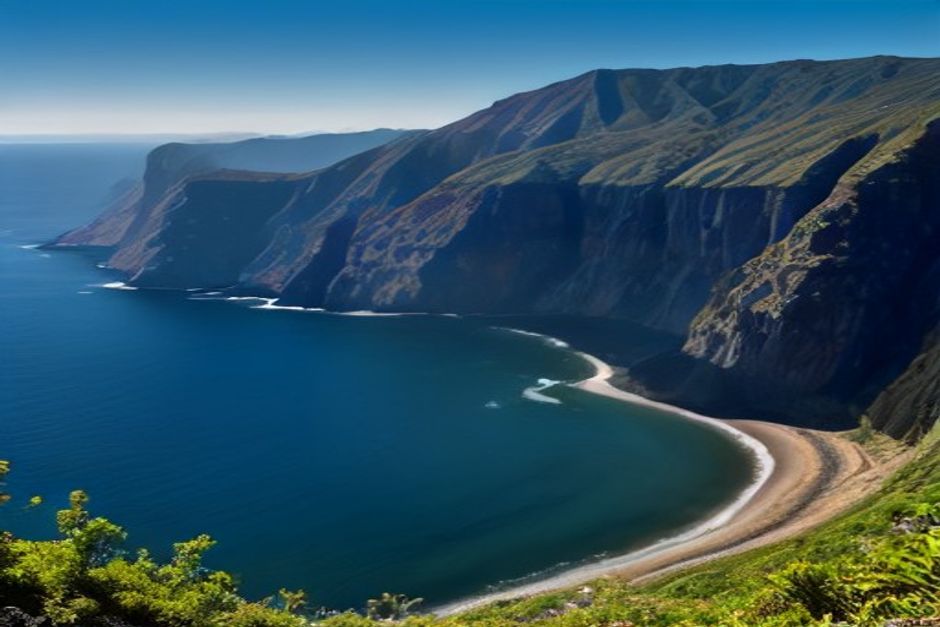
Why was Garajau made Madeira's first marine reserve?
Because the reef had been fished close to empty. By the 1980s, decades of spearfishing and netting along this stretch of volcanic coast had thinned out the larger, slower-breeding species almost entirely — the fish that take years to mature were the first to disappear. The 1986 legislation banned hunting and fishing within the reserve's boundaries outright, giving the reef the one thing overfished ground rarely gets: time left completely alone. It became the model other Madeiran marine reserves, including the one around the Desertas Islands, were later built on.
What can you see underwater at Garajau?
Fish that have grown old, which is rarer than it sounds. Decades without fishing pressure means Garajau now holds a healthy population of dusky grouper — a species that can live for decades and grows heavier the longer it's left undisturbed, so a big one here is a direct sign the protection is working. Moray eels sit in the rock crevices, garden eels sway in sandy patches, and octopus and large shoals of bream and damselfish move over the reef in numbers you don't see on unprotected coastline nearby. Rays, including the occasional devil ray, pass through the deeper water at the edge of the reserve.
Is the Cristo Rei statue part of the reserve?
Not legally, but it's the reserve's unmistakable landmark. The 15-metre statue of Christ the King stands on the clifftop at Ponta do Garajau, arms open to the Atlantic, unveiled in 1927 — a few years before Rio de Janeiro's famous version and built in the same Art Deco style by French sculptor Georges Serraz. It sits directly above the water it now watches over, and the viewpoint around its base gives one of the better free panoramas on Madeira's south coast, looking straight down onto the reef it shares a name with.
Can you dive or snorkel in Garajau, and where do you go?
Yes, and it's the main reason people come. The public access point is at Caniço de Baixo, where a beach platform leads straight into reserve water, making it one of the easiest places on the island to snorkel without a boat. Several dive centres are based in the same small resort and run regular boat and shore dives inside the reserve, with visibility that regularly exceeds 20 metres in summer. Anyone snorkelling independently should stay close to shore and away from dive boat moorings, since some zones are set aside for diving traffic.
Is Garajau reachable by boat from Funchal?
Yes — it's a short run east along the coast from Marina do Funchal, close enough that boats based in the marina pass it on the way toward Caniço and Santa Cruz. Chifbay's routes run the other direction, west toward Câmara de Lobos, Cabo Girão and Fajã dos Padres, but the same principle applies at both ends of the coast: a private boat gets you directly over water that's genuinely worth looking at, rather than watching it from a clifftop road.
Forty years of leaving one reef alone did more for it than any restocking programme could.
Garajau isn't dramatic in the way Cabo Girão or the Desertas Islands are — there's no towering cliff or open-ocean wildlife spectacle. What it offers instead is quieter and, in its own way, more remarkable: proof of what Madeira's coastline looks like when it's simply left to recover.