Once a year, the hillsides above Machico catch fire on purpose. The Festa dos Fachos is one of Madeira's oldest surviving traditions — a night of flaming wooden structures, conch-shell calls and a story that goes back to pirate raids. Here's what it is, when it happens in 2026, and where to watch.
When is the Festa dos Fachos in 2026?
The fachos burn on Saturday, 29 August 2026, as the centrepiece of Machico's Festa do Santíssimo Sacramento, a two-day feast running 29–30 August. After evening Mass, around 21:00, the sound of the búzio — a conch shell — echoes through the valley for about 30 minutes, building toward the moment the fachos are set alight.
What is a facho?
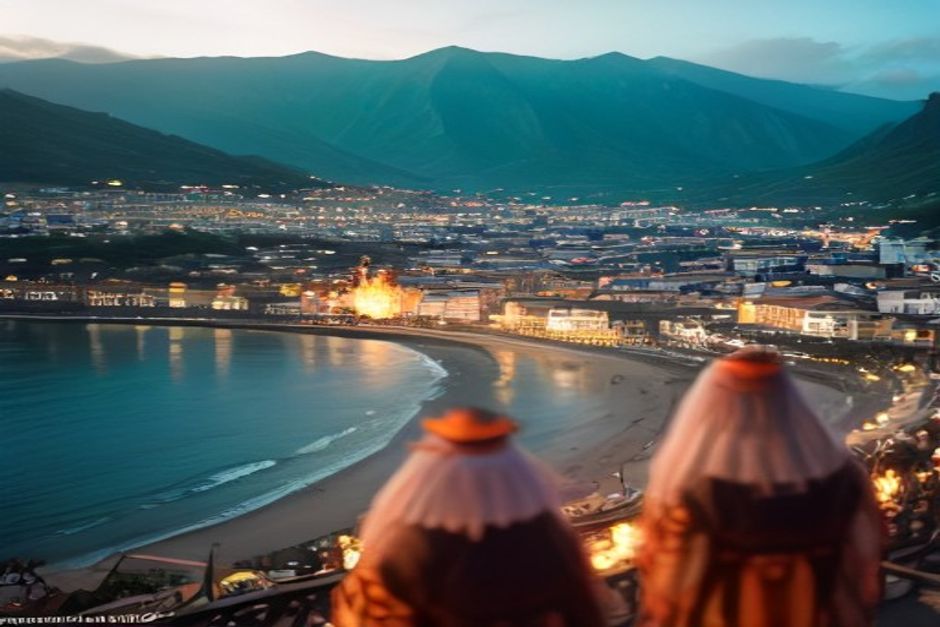
A facho is a large wooden structure, soaked and wrapped so it burns slowly rather than flaring out in seconds, built into a recognisable shape — a cross, a chalice, a fish, a boat, or another symbol tied to Machico's history and its relationship with the sea. Dozens are prepared in the weeks before the festival by local families and neighbourhood groups, then carried or hauled into position on the hillsides above the town. When they're lit together, the ridgeline above Machico glows against the night sky.
Where does the tradition come from?
It's a defensive signal turned into a celebration. Between the 16th and 18th centuries, Madeira's coastal towns were regular targets for pirate and corsair raids, and Machico — an early, wealthy settlement on the exposed east coast — was no exception. Bonfires and flares lit from high points such as Pico do Facho warned residents that ships had been sighted, giving them time to mobilise and defend the town. The fires eventually lost their military purpose but never went out; over the centuries the warning beacons were folded into the Festa do Santíssimo Sacramento and turned into the elaborate, symbolic fachos lit today.
What actually happens on the night?
The evening builds slowly and then arrives all at once. After Mass, the town gathers in and around the main square as the búzio sounds, and locals with family ties to specific fachos head up to their hillside spot. Once the flames catch, the hills around the Machico valley — Pico do Facho among them — light up in points of orange against the dark, some structures blazing for well over an hour. Back in town, the square fills with music, food stalls and a genuinely local crowd; this is a parish feast first, and a spectacle for visitors second, which is exactly what makes it worth seeing.
Where's the best place to watch it?
For the widest view of the burning hillsides, Pico do Facho itself — the viewpoint north of Machico, on the road before the tunnel to Caniçal, at around 280 metres — gives you the classic panorama over the valley and several fachos at once. For the atmosphere, the búzio call and the crowd, stay closer to the centre: Largo dos Franceses and the streets around Machico's parish church put you in the middle of the celebration rather than looking at it from a distance. Arriving by late afternoon or early evening is the practical move — it gives you time to find a spot, eat, and settle in before the fires start at dusk.

How do you get to Machico from Funchal?
Machico sits on Madeira's east coast, about 25–30 minutes from Funchal by car or taxi along the VE1 expressway, and it's also served by public bus. There's no shortage of parking for a normal day, but a festival night in a small town is a different story — go early, or let someone else drive. It's worth treating as its own outing: Machico is well beyond the stretch of coastline a private boat from Marina do Funchal actually covers, so save the water for a separate day. A private boat trip with Chifbay runs the closer south-west coast — Câmara de Lobos, Cabo Girão and the coves toward Ribeira Brava — which pairs naturally with an afternoon on deck rather than an evening inland.
Is Machico worth visiting beyond the festival?
Yes. Machico was Madeira's first capital and the site of the island's earliest Portuguese settlement, and it still has the layout of an old maritime town — a long black-sand-and-shingle beach, a 15th-century fort, and a parish church dating to the island's earliest years. Outside festival weekend it's a quieter, more workaday counterpoint to Funchal, with good seafront restaurants and none of the marina crowds. Combine a morning wandering the old town with an afternoon back on the water and you get two very different sides of the island in one trip.
Machico lit these hills to warn of danger once. Now it lights them to remember.
If your dates line up with 29 August, it's one of the most striking things you'll see on the island — and a reminder that Madeira's best traditions aren't staged for visitors, they just happen to be worth the drive.